Departure in Siberia
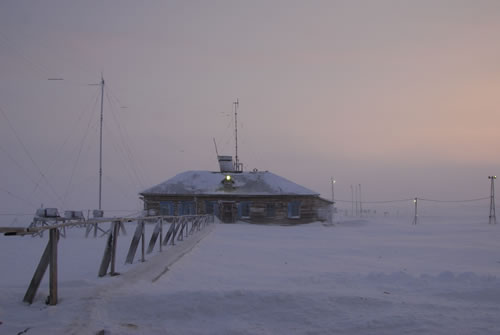
Some Russian scientists actually live in this Golomanyi meteorological station lost in the middle of nowhere. Or, should we say

Some Russian scientists actually live in this Golomanyi meteorological station lost in the middle of nowhere. Or, should we say "survive"?

Contact us

Please feel free to drop us a mail with your comments and suggestions.

Full Gallery

  • In Siberia, you sometimes have to wait for hours for your plane to come in.
  • On the helicoter MI8 that will bring them to the departure point, Alain looks over his notes.
  • Dikson: a place on the edge of the world, buried under snow and ice during two months of the year.
  • The expedition equipment is loaded onto the MI8 helicopter.
  • Refuelling of the MI8 helicopter
  • Room is rather short on the MI 8 helicopter and the loud turbines are a guaranteed nuisance.
  • Dikson: we had to land in order to fuel up.
  • The MI8 helicopters will carry anyone almost anywhere in Siberia.
  • They arrive in Golomanyi, a tiny Russian meteorological station lost in the middle of nowhere.
  • One of the two buildings located in Golomanyi.
  • The stop-over in Golomanyi allows Alain and Dixie to make all necessary verifications one last time.
  • Some Russian scientists actually live in this Golomanyi meteorological station lost in the middle of nowhere. Or, should we say
  • The expedition has to make a stop-over in Golomanyi, waiting for milder weather to come.
  • In Golomanyi, you can already feel the polar cold; this photo was taken by -42°C!
  • During their waiting time in Golomanyi, the two men test all their equipment before the departure.
  • While they are waiting for the helicopter, Alain and Dixie explore Golomanyi's surroundings.
  • Being that we have some time to loose, we take a couple of pictures and film some short sequences off Golomanyi, for the purpose of our archives.
  • While they are waiting for the MI8 helicopter, the two men work out.
  • The landing of the MI8 helicopter in Golomanyi.
  • Golomanyi: the big building in the foreground is a warehouse while the two other buildings on the right of the picture show the meteorological station and the housing facilities.
  • As they approach the drop-off point, the two men can already look out and see the state of the ice.
  • An interesting document showing what an open water runner is (a ‘lead', as we call it in polar jargon). These leads can stretch several hundreds of meters wide; and one must cross them!
  • The two men have just been dropped off at the departure point; it is still night time.
  • The place where they have been dropped off, a few kilometres away from Cape Arctichewski: 82°00'32
  • March 1, 2007: the two men take off in the polar night with almost 4000 km of ice before them.

Focus on

Expedition website

The Coldest Journey (Sir Ranulph Fiennes & Team)

Antarctic 2012-2013 - ongoing

25.10.2012

Sir Ranulph Fiennes is back in the Antarctic for a world first. He will lead a team of explorers to conquer…


Support the IPF

Support us

All donations to the IPF are tax deductible.

Donations can be made by various means, depending if they are made by a company or by individuals.

Support Us


Shop online

Shop Online

Browse our products

Some of our educational products can be purchased online (CD-ROMs, comic strips)

We also have T-shirts and other products of the like.


Keep in Touch

RSS Feeds

Subscribe to our RSS feeds to be warned in real time when the website is updated.